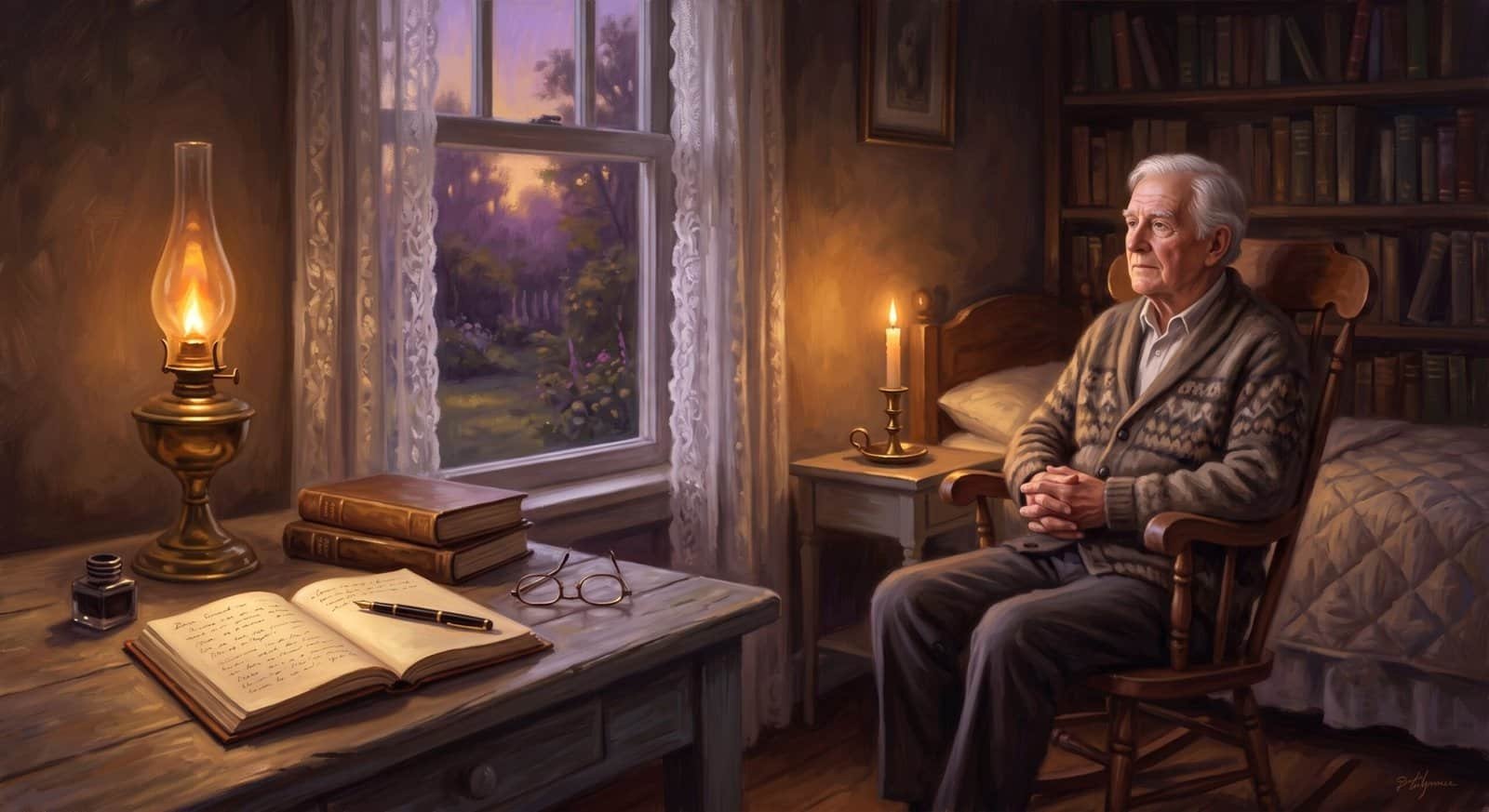
The Evening Brings Its Lamps
From The Hearth
July 1, 2026
The evening of a well-spent life brings its lamps with it.
Joseph Joubert
About the Author
Joseph Joubert (1754–1824) is one of history’s most beloved writers who never published a single book. Born in the small town of Montignac in southwestern France, he studied law, taught for a time, and made his way to Paris, where he moved among the great minds of his age — he knew Diderot in his youth and became the trusted friend and mentor of the writer Chateaubriand in his later years. He lived through the French Revolution, serving quietly as a justice of the peace in his hometown while Paris burned, and was later appointed by Napoleon to help oversee the universities of France. But his real life’s work happened in private. For more than forty years, nearly every day, Joubert wrote down his thoughts in small notebooks — on faith, on kindness, on how to live — polishing each sentence the way a jeweler polishes a stone. He once said his ambition was to put a whole book into a page, a whole page into a sentence. He died at sixty-nine having shown those notebooks to almost no one. He simply lived carefully, thought deeply, and wrote it down.
Historical Context
This line comes from those private notebooks, the Pensées, written by a man watching his own evening approach. Joubert had survived one of the most violent upheavals in human history — the Revolution, the Terror, the rise and fall of Napoleon — and had seen brilliant careers ignite and collapse all around him. He chose a different way: a small life, faithfully kept. The image he reaches for is drawn from the world he knew, a world before electric light, where evening meant darkness unless someone had prepared — unless the lamps had been filled, trimmed, and carried in. His point is quiet but firm: the light we have at the end of life is not handed to us at the end. It is accumulated along the way. A well-spent life does not arrive at its evening and find darkness waiting; it arrives carrying its own lamps — the faith practiced, the kindnesses given, the promises kept, the people loved — and by their light, the evening becomes the gentlest part of the day.
A Story to Sit With
When Joubert died in 1824, the notebooks might easily have died with him. They were private jottings — forty years of them — never organized, never intended for the press. But his friend Chateaubriand, by then one of the most famous writers in Europe, could not let them disappear. Fourteen years after Joubert’s death, he gathered a selection and published it for Joubert’s friends and family, and the world discovered that this quiet, unpublished man had been one of the finest minds of his century. Writers from Matthew Arnold to our own day have treasured him since.
Think about what that means. Joubert spent his evenings filling lamps no one could see — a sentence here, a thought there, faithfully, for four decades — with no promise that any of it would ever give light beyond his own desk. And then, after he was gone, the lamps were carried out into the world, and they are burning still, two hundred years later, in a grandfather’s book in Utah. That is how a well-spent life works. You fill the lamps in obscurity. God decides how far the light will travel.
Scripture Cross-Links
Matthew 25:4 — “But the wise took oil in their vessels with their lamps.” The wise virgins and Joubert are teaching the same lesson: the light of the evening is gathered long before the evening comes.
Proverbs 4:18 — “But the path of the just is as the shining light, that shineth more and more unto the perfect day.”
Psalm 92:14 — “They shall still bring forth fruit in old age; they shall be fat and flourishing.”
Doctrine and Covenants 88:67 — “And if your eye be single to my glory, your whole bodies shall be filled with light, and that body which is filled with light comprehendeth all things.”
Galatians 6:9 — “And let us not be weary in well doing: for in due season we shall reap, if we faint not.”
Thematic Reflection
There is a widespread fear of growing old, and underneath it, I think, is a fear of arriving at life’s evening empty-handed — of finding the light gone and nothing to see by. Joubert answers that fear with a promise, but it is a conditional promise: the well-spent life brings its lamps. The evening itself provides nothing; it only reveals what we have been carrying all along. Every honest day’s work, every prayer offered when no one was watching, every temptation refused, every child comforted, every visit made to someone lonely — each of these is oil poured quietly into a vessel. For years it can feel like nothing is accumulating at all. Then the evening comes, and the person who lived that way discovers something the world does not expect: the last light of the day is the warmest. Not because the body is strong — it usually isn’t — but because the soul is stocked. Memory becomes a lamp. Testimony becomes a lamp. Old friendships, long marriages, children grown good — lamps, all of them, lit one by one as the daylight fades. The gospel does not promise us an evening without darkness at the windows. It promises that those who have walked with the Lord will not sit in that darkness. They brought their lamps with them and they were filled with oil.
Richard’s Personal Reflection
I am in the evening Joubert describes, or at least in the late afternoon of it, and I can tell you from inside that he was right. As I began to ponder retirement, I honestly wondered what will be left when the white coat comes off — whether the light in my life has been the work itself and would go out with it. Or would I find light from the lamps I lit throughout my life? The lamps I find burning now were all filled earlier, most of them without my noticing: the years beside Grandma, the children we raised and the grandchildren they gave us, the quiet mornings with the scriptures, the thousands of small moments in exam rooms that taught me what a human life is worth. None of those felt like lamp-filling at the time. They felt like Tuesday. But here in the evening, they are what I see by. This book you are holding is itself one of those lamps — I am spending my evenings writing it by the light of everything that came before.
Grandfather’s Counsel
My dear ones, you are young, and the evening I am describing feels impossibly far away to you. That is exactly why I am telling you this now: the lamps of your evening are being filled today. Every choice you make in your teens and twenties and thirties — how you treat people, whether you keep your covenants, whether you tell the truth when it costs you, whether you show up for the people who need you — every one of those choices is oil in a vessel you will not open for fifty years. You cannot fill the lamps at sunset. The oil must be gathered in the daylight, a little at a time, when it seems least necessary. So spend your days well — not perfectly, none of us manages that, but honestly and faithfully. Then one day, a long time from now, when your own evening comes, you will find what your grandfather found: that the darkness holds no fear for the one who arrives carrying light. Fill your lamps, my dear ones. Evening is kinder than you think — to those who come prepared.
Not to Speak Is to SpeakNext →
The Liberty to Study Poetry
If this spoke to you, sit a while with