The Vale of Soul-Making
From The Hearth
June 11, 2026
Do you not see how necessary a world of pains and troubles is to school an intelligence and make it a soul?
John Keats
About the Author
John Keats (1795–1821) lived for only twenty-five years, and almost every one of them was marked by loss. His father died in a riding accident when John was eight. His mother died of tuberculosis when he was fourteen — the same disease that would eventually take him. He was apprenticed to a surgeon and apothecary, qualified as a physician’s assistant, and then did something that shocked his guardians: he walked away from medicine to write poetry. He had been writing for only six years when consumption announced itself in his lungs with a cough that left blood on his handkerchief. He knew what that meant — he had watched the disease take his mother and his brother Tom, the very brother beside whose sickbed this letter was written. He packed himself off to Rome in hopes the warmer air might buy him more time. It did not. He died in a rented room near the Spanish Steps, asking that his epitaph read only: Here lies one whose name was writ in water. He was twenty-five. The poems he left behind — “Ode to a Nightingale,” “Ode on a Grecian Urn,” “To Autumn” — are among the most beautiful in the English language. He wrote them all in less than two years, while dying.
Historical Context
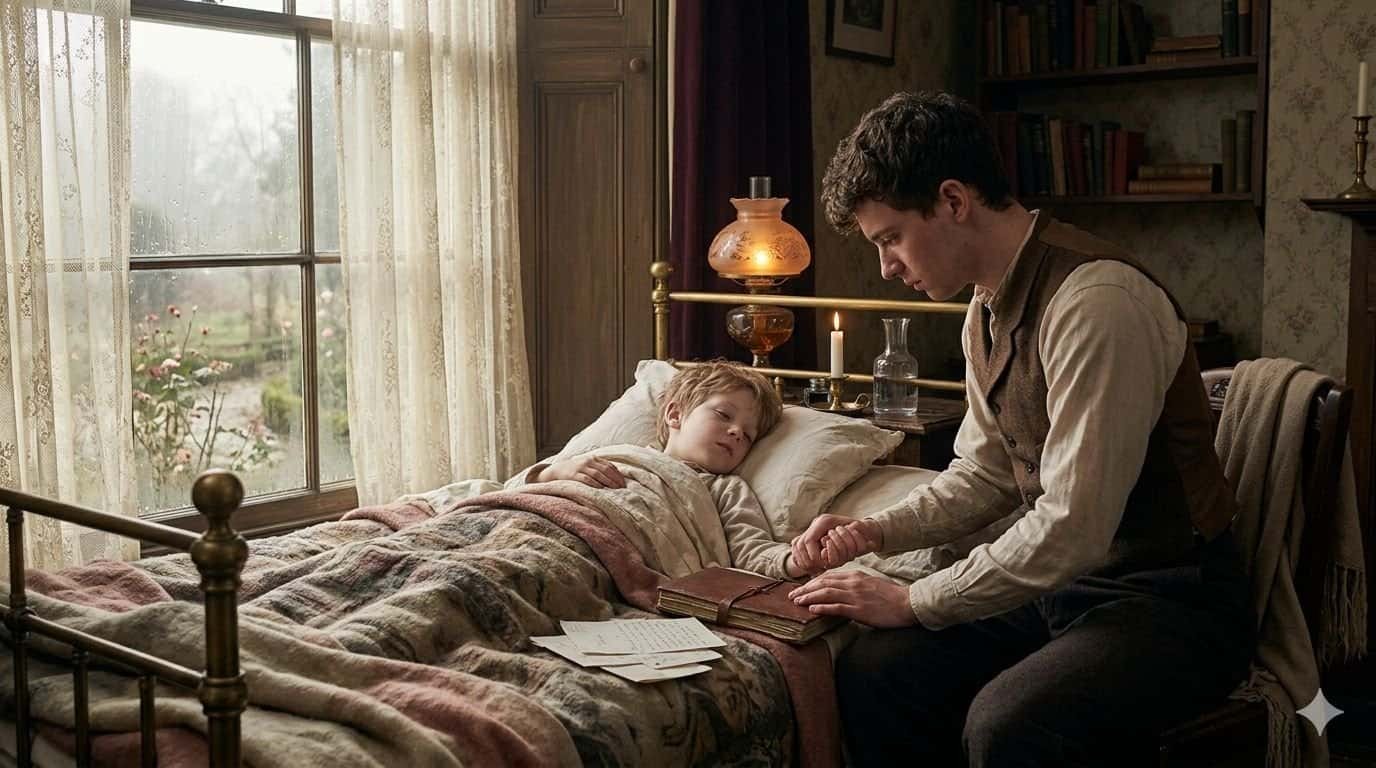
This sentence comes from a letter Keats wrote to his brother George and sister-in-law Georgiana in April 1819. He was sitting at the bedside of his youngest brother Tom, who was then in the final stages of consumption. Keats was not writing as a philosopher at leisure — he was writing as a man watching someone he loved lose his grip on life, day by day, in the very room where they slept as boys.
Out of that vigil came one of the most quietly profound theological reflections in all of English letters. Keats called it “a grander system of salvation than the Christian religion” — and then proceeded to describe something that sounded remarkably like what Christians had been saying all along about suffering and sanctification. He argued that human beings are not born as souls. They are born as intelligences — bright, capable, but unformed. It is the world of pains and troubles, he wrote, that does the actual work of making a soul out of that raw intelligence. The world, he said, is not a vale of tears. It is a vale of soul-making. And the school, he concluded, requires difficulty as its curriculum.
He was twenty-three years old. He had already buried a father, a mother, and was watching a brother die. He knew the vale from the inside.
A Story to Sit With
In the winter of 1818, John Keats abandoned his own ambitions and moved back into the family lodgings to nurse his brother Tom through the final stages of tuberculosis. Tom was nineteen. John was twenty-three.
He slept in the next room. He brought food, changed linens, read aloud. He watched the brother he had grown up with — shared a bed with as children — grow lighter and quieter and then, in December of 1818, stop breathing altogether.
Most men would have been destroyed by it. Keats sat down and wrote.
In the months that followed — what scholars now call his “Great Year” — he produced poem after poem of extraordinary beauty: “The Eve of St. Agnes,” “La Belle Dame Sans Merci,” the great Odes. Scholars have spent two hundred years trying to explain how grief and genius combined in him to produce that particular harvest. Part of the answer may be in the letter itself. He had come to believe, at the cellular level, that what had happened to him in that room beside Tom was not merely loss — it was formation. That something had been made in him through that long winter of watching that could not have been made any other way. The vale of soul-making was not a theory. It was a room he had lived in.
Scripture Cross-Links
Romans 5:3–4 — “We glory in tribulations also: knowing that tribulation worketh patience; and patience, experience; and experience, hope.”
James 1:3–4 — “The trying of your faith worketh patience. But let patience have her perfect work, that ye may be perfect and entire, wanting nothing.”
2 Nephi 2:2 — “Thou knowest the greatness of God; and he shall consecrate thine afflictions for thy gain.”
Doctrine and Covenants 122:7 — “All these things shall give thee experience, and shall be for thy good.”
Hebrews 5:8 — “Though he were a Son, yet learned he obedience by the things which he suffered.”
Thematic Reflection
There is a question every honest person eventually asks in the dark: What is the point of this? What is the point of the grief, the disappointment, the body that betrays you, the prayer that seems to go unanswered? Why is the world arranged this way?
Keats offers one of the most honest answers ever written — and he offers it not from a library chair but from a sickroom floor. The world is a vale, he says. Not a pleasure garden, not an obstacle course, not a punishment — a vale. A valley you pass through on the way to becoming something. And what you become, he argues, is a soul. Not an intelligence — you had that to begin with. A soul. The difference is the schooling. The curriculum is pain.
This is not cruelty dressed up as philosophy. It is the logic of every growing thing. The tree that has wrestled wind has deeper roots than the tree that grew in a greenhouse. The surgeon whose hands have steadied through long hard years develops a skill that cannot be downloaded or transferred — it can only be grown, and only through the doing of hard things over time. The person who has lost someone and survived the loss knows something about love and impermanence that cannot be taught any other way.
Latter-day scripture says the same thing in plainer language: all these things shall give thee experience, and shall be for thy good. Not some things. All things. The vale is not a mistake. It is the design.
Richard’s Personal Reflection
Thirty years of internal medicine is, among other things, a long graduate seminar in the vale of soul-making.
I have watched patients walk into my office as one kind of person and walk out of a diagnosis as something new. Not always better at first — sometimes shattered, sometimes terrified. But I have seen what happens, over time, to the ones who do not run from the valley. They become unusually tender with other people who are afraid. They become more honest about what actually matters. They become, in ways that are hard to articulate but impossible to miss, more fully themselves — as though the suffering had burned away what was pretense and left what was real.
I have also watched the opposite: people who spend every ounce of their energy trying to avoid the vale entirely — who insist on a diagnosis they prefer, who manage symptoms without ever asking what the symptoms are teaching them, who treat their own hardship as an injustice to be protested rather than a school to be attended. They do not seem to become less. But they do not seem to become more, either. The vale cannot do its work in a person who refuses to enter it.
I learned this, imperfectly, from my own patients. And I learned it from medicine itself — from the long nights on call, from the cases I could not fix, from the grief of losing people I had cared for for years. Those losses made me a different physician than I would have been without them. Whether they made me a better one I cannot say with certainty. But they made me a deeper one. They made me, I think, more of a soul.
Grandma has known this intuitively her entire life. She does not resist the hard passages. She enters them with her eyes open and her hands folded, and she comes out the other side having understood something about God that she could not have learned anywhere else. I have tried to follow her into those rooms. She has been the best teacher I have had.
Grandfather’s Counsel
My dear ones, there will come a time — perhaps more than one — when life will put you through something that feels simply unfair. A loss you didn’t deserve. A door that closed when it should have opened. A valley you didn’t choose and wouldn’t have, given any other option.
I want you to know something about that valley before you reach it.
You are not being punished. You are being schooled. There is a difference that matters enormously.
Keats wrote this from one of the hardest rooms of his life, watching someone he loved leave the world too early. And what he saw, in that room, was not just grief. He saw that something was being made in him that could not have been made any other way. Intelligence does not become a soul on easy days. It becomes a soul in the vale — in the long, slow, honest work of passing through difficulty with your faith intact.
So pass through. Don’t camp in the valley, but don’t flee it either. Walk through it with your eyes open. Ask what it is teaching you. And trust — because this is what I have learned in a long life and a long career — that the God who designed this world designed it as a school, not a trap. He is not absent from the hard passages. He is there, teaching, the way the best teachers teach: by letting you do the hard work yourself, because He knows that you cannot become what He wants you to become any other way.
The vale is not the end of the story. It is the school in the middle of it. Graduate with your soul intact.
—
The Gift of the Present GazeNext →
The Only Hunger That Never Ends