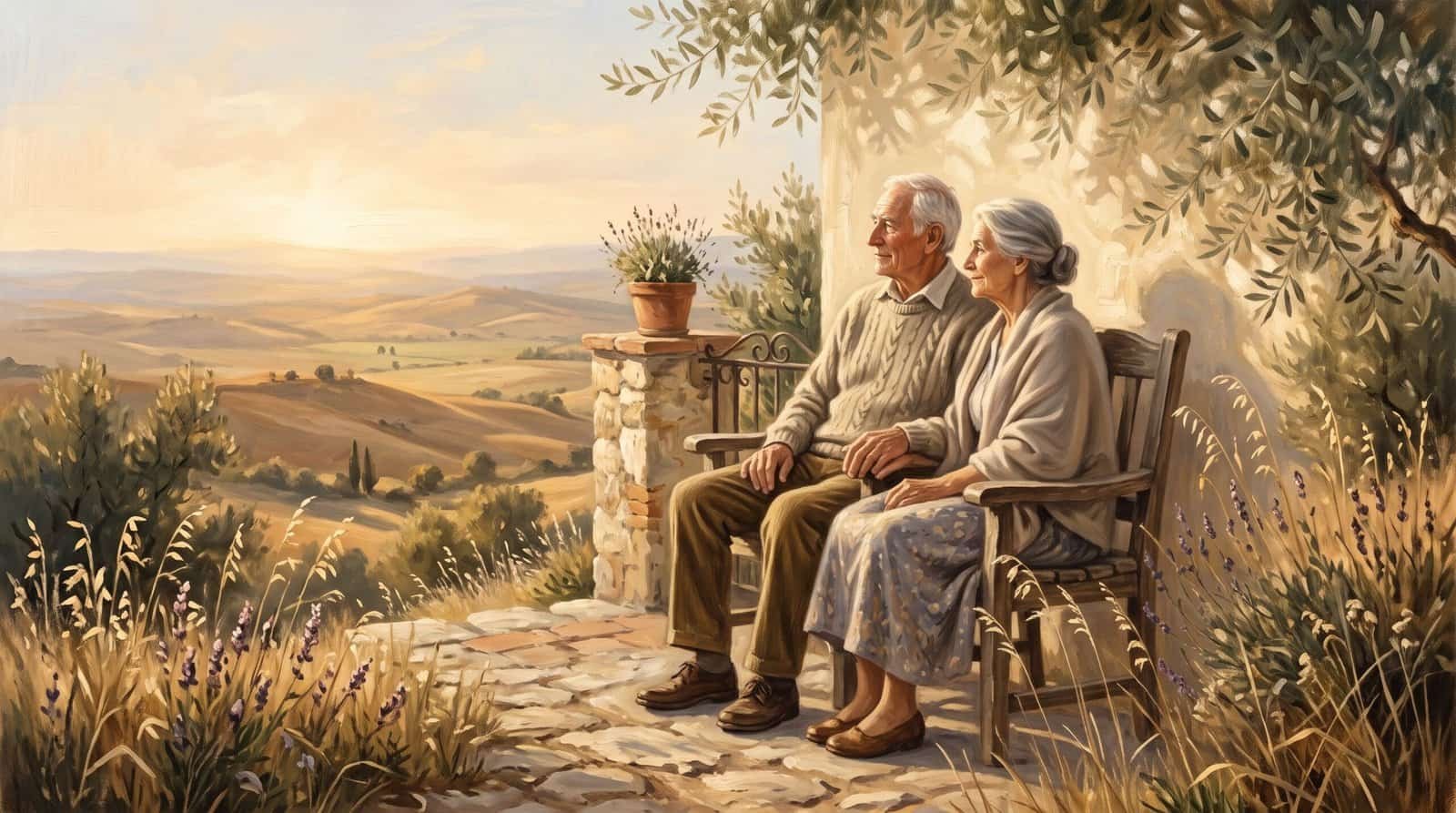
Looking Outward Together
From The Hearth
June 29, 2026
About the Author
Antoine de Saint-Exupéry (1900–1944) was a French aristocrat, a pioneering airmail pilot, and the author of The Little Prince — one of the most beloved books ever written, translated into more languages than almost any work outside scripture. Long before he was a novelist, he was a flyer of the most dangerous kind: in the 1920s he carried mail across the Sahara and the Andes in open-cockpit biplanes with no radio, no reliable maps, and no guarantee of rescue if he went down. He crashed more than once. He nearly died of thirst in the desert after one such crash, an ordeal that shaped much of his later writing. He flew reconnaissance missions for France in the Second World War even after he was technically too old and too injured to qualify, and in July 1944 he took off on a mission over the Mediterranean and never returned. His plane wasn’t found until decades later, off the coast near Marseille. He wrote The Little Prince in exile in New York during the war, grieving his occupied homeland, and somehow produced from that grief one of the gentlest and wisest books in the world. He understood partnership not as an abstraction but as a daily, physical reality — he had spent his working life seated beside other men in the cramped cockpits of dangerous aircraft, each of them depending entirely on the other to watch the instruments, read the weather, and bring them both home alive.
Historical Context
This line comes from Wind, Sand and Stars (1939), Saint-Exupéry’s memoir of his years flying mail across remote and hostile terrain. He is not writing about romance in the conventional sense when he sets down this sentence — he is writing about the bond that forms between people who are working toward something together, shoulder to shoulder, eyes fixed on the same horizon rather than on each other. But the line escaped its original context almost immediately and became one of the most quoted sentences about marriage in the twentieth century, because people recognized something true in it: that the relationships which last are rarely the ones built on staring into each other’s eyes in perpetual fascination, but the ones built on facing the same direction — the same purpose, the same faith, the same children, the same God — side by side.
Scripture Cross-Links
Ecclesiastes 4:9–10 — “Two are better than one… for if they fall, the one will lift up his fellow.”
Amos 3:3 — “Can two walk together, except they be agreed?”
Mosiah 18:21 — “And he commanded them that there should be no contention one with another, but that they should look forward with one eye, having one faith and one baptism, having their hearts knit together in unity and in love one towards another.”
Doctrine and Covenants 88:67 — “And if your eye be single to my glory, your whole bodies shall be filled with light.”
Thematic Reflection
We are handed, almost from childhood, a picture of love as two faces turned toward each other — the long gaze, the locked eyes, the absorbed attention of one person fixed entirely on another. There is real tenderness in that picture, and a marriage needs moments of it. But Saint-Exupéry, who had spent his life in cockpits beside other men whose full attention had to be on the horizon and not on him, knew something that the gazing picture leaves out: a partnership sustained only by mutual staring eventually runs out of road. What carries two people across decades is not how intently they study each other’s faces but whether they are looking, together, at the same far point — the same purpose, the same children, the same eternity. Scripture calls this having “one eye,” hearts “knit together” by a shared direction rather than a shared stare. It is the difference between two people admiring each other and two people rowing the same boat toward the same shore.
Richard’s Personal Reflection
In thirty years of medicine I watched a great many marriages up close, often at their hardest moments — in waiting rooms, in hospital corridors, in the quiet after a difficult diagnosis. The marriages that held together under that kind of pressure were almost never the ones where the couple seemed romantically dazzled by each other in the conventional sense. They were the ones where I could see, even in a five-minute exchange, that husband and wife were oriented the same way — toward the same faith, the same children, the same decisions about care, the same hope. They weren’t gazing at each other in the waiting room; they were looking together at whatever was in front of them, and somehow that made all the difference in how they bore it. Grandma and I have tried, across our years together, to be the kind of partnership that keeps choosing the same direction — temple, family, faith, service — even on days when looking at each other directly might have been hard. I have come to believe that is what actually holds a marriage upright. Not the gaze. The shared horizon.
Grandfather’s Counsel
My dear ones, when you choose a companion, do not only ask whether you love gazing at this person — ask whether you can imagine looking outward beside them, year after year, at the same things: at God, at family, at the work He has given you to do together. Faces fade in their fascination; you will not always feel the flutter of new love, and that is normal, not failure. What endures is direction. Choose someone who wants to walk where you are walking, who treasures what you treasure, who will keep their eye single with you even when the way grows hard. And once you have chosen, do the daily work of turning together to face the same horizon. That, far more than any gaze, is what will carry you home.
The Worthwhile ArrivalNext →
The Courage to Continue