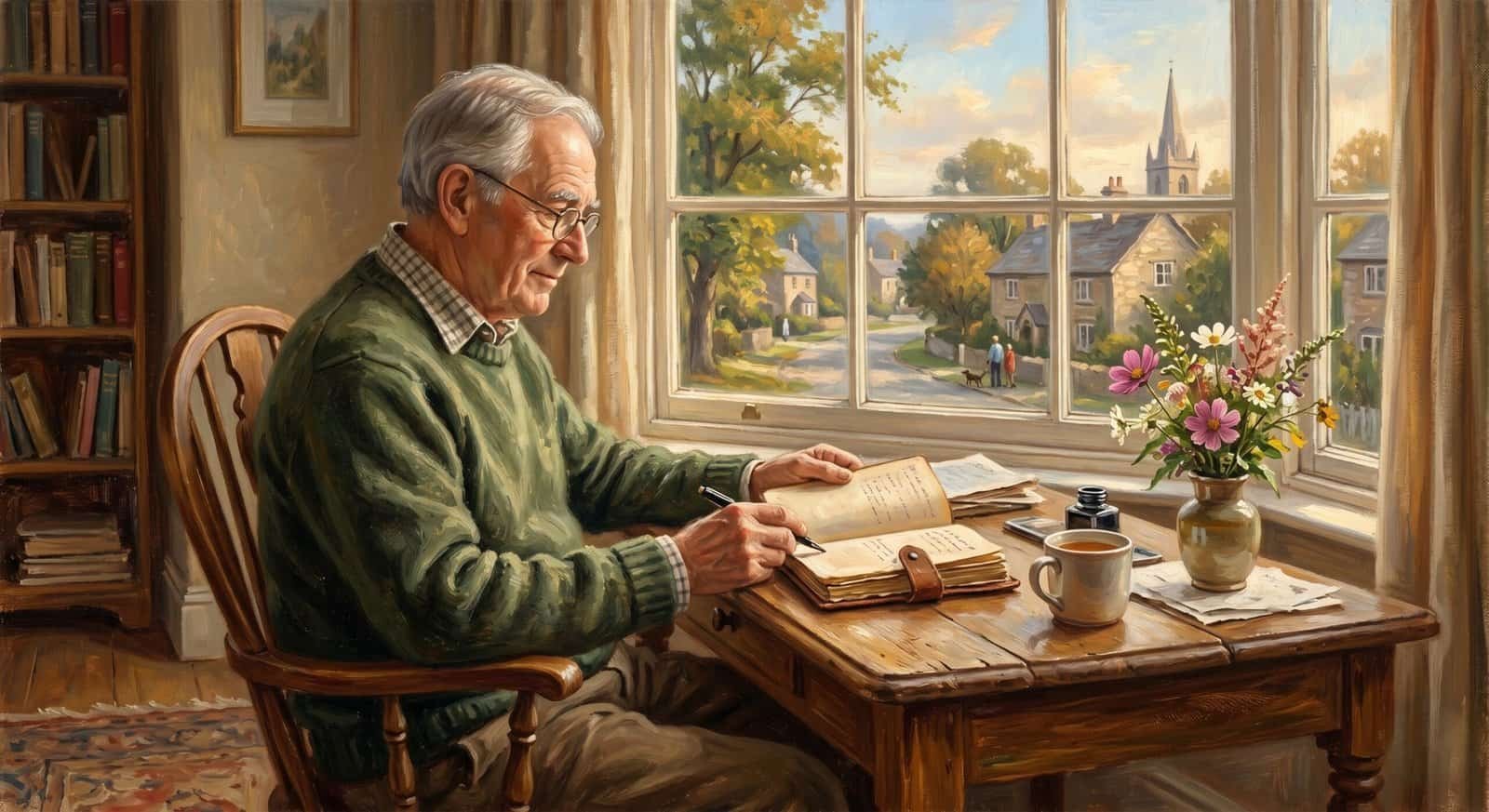
The Only Reason — George Eliot
From The Hearth
June 22, 2026
What do we live for, if it is not to make life less difficult for each other?
George Eliot
About the Author
Mary Ann Evans (1819–1880) published every word of her fiction under the name George Eliot — a man’s name, chosen deliberately, because she knew the literary world would not take a woman seriously, and she had things to say that the world needed to hear. She was right on both counts.
She grew up in Warwickshire, England, the daughter of a land agent who managed estates in the English countryside. She was, by all accounts, an odd and intense child — plain-featured, she was told, but possessed of a mind that left people unsettled in the best way. She read voraciously, spoke several languages, and by the time she was in her twenties had translated some of the most challenging theological and philosophical texts of the era from German into English — including works by Spinoza and Strauss that questioned the historical foundations of Christian scripture. She lost her institutional faith. But she never lost her moral seriousness, her compassion, or her conviction that human beings owe one another something deep and daily.
She began writing fiction in her late thirties, producing in the next twenty years a body of work that many consider the summit of the Victorian novel: Adam Bede, The Mill on the Floss, Silas Marner, Middlemarch. Henry James called her the greatest living writer in the English language. Tolstoy read her and wept.
What makes Eliot extraordinary is what she does with ordinary people. Her novels do not follow the famous, the powerful, or the dramatic. They follow farmers and weavers and country doctors and quietly suffering women — and she insists, page after page, that their lives matter enormously. That what they choose to do with each other matters. That the quality of one human being’s care for another is the central fact of civilization.
She died in 1880, in London, having lived fully and honestly and on her own terms. The epitaph that could stand above every page she wrote is the sentence you read at the top of this entry.
Historical Context
This line comes from Middlemarch (1871–1872), widely regarded as the greatest novel in the English language. It appears in a context of quiet moral reckoning — a character sitting with the question of what any life finally amounts to, stripped of its ambitions and its appearances.
Eliot was writing in an era of enormous social change. The Industrial Revolution had moved millions of people from the rhythms of rural life into cities, into factories, into anonymity. The old structures of community — the parish, the village green, the neighborhood where you knew every face — were fracturing. People were becoming strangers to one another at an accelerating rate. Into that world, Eliot asked the simplest and most radical question she could think of: Why are we here?
She did not answer it with theology. She answered it with ethics: we are here to make things less difficult for each other. Not to solve everything. Not to fix the world. Not to achieve greatness. Simply to reduce, by whatever small measure we can manage today, the difficulty of someone else’s existence.
It is a humble answer. It is also a very large one.
A Story to Sit With
In Middlemarch, there is a character named Dorothea Brooke — young, idealistic, brilliantly minded, married to the wrong man and living in a small English town when she had imagined she might change the world. She does not change the world. The novel ends quietly, and Eliot’s famous final paragraph acknowledges that Dorothea’s life produced no great monuments, no historical legacy, no headline.
And then Eliot writes one of the most luminous sentences in all of literature: “The growing good of the world is partly dependent on unhistoric acts; and that things are not so ill with you and me as they might have been, is half owing to the number who lived faithfully a hidden life.”
A hidden life. A life of unhistoric acts. A life of making things less difficult for the people right in front of you.
That is what Eliot is honoring. That is what she is saying we are for.
Scripture Cross-Links
Mosiah 2:17 — “When ye are in the service of your fellow beings ye are only in the service of your God.”
Matthew 25:40 — “Inasmuch as ye have done it unto one of the least of these my brethren, ye have done it unto me.”
Galatians 6:2 — “Bear ye one another’s burdens, and so fulfil the law of Christ.”
John 13:34 — “A new commandment I give unto you, That ye love one another; as I have loved you.”
D&C 81:5 — “Succor the weak, lift up the hands which hang down, and strengthen the feeble knees.”
Thematic Reflection
George Eliot was not a woman of conventional faith, but she arrived, through a lifetime of clear-eyed thinking, at the very center of what every great religious tradition has always taught: that love is not an abstraction. It is a practice. It is something you do — quietly, daily, without fanfare — for the person standing in front of you.
What do we live for, if it is not to make life less difficult for each other?
Notice what she does not say. She does not say: to achieve greatness, to leave a legacy, to build a monument, to be remembered. She says: to make life — the actual texture of someone’s actual day — less difficult. The grocery carried. The door held. The kind word offered when unkindness would have been so much easier. The listening ear. The hand on the shoulder. The visit made when staying home would have been perfectly excusable.
These are small things. They are also, George Eliot insists, the very reason we are here.
The Savior said it this way: inasmuch as ye have done it unto the least of these, ye have done it unto me. He was not speaking of great programs or historic initiatives. He was speaking of a cup of cold water. He was speaking of the hidden acts — the ones no one records, the ones Heaven notices.
Richard’s Personal Reflection
I went to church today without any particular agenda. The meeting was ordinary in the best sense — a congregation of people trying, imperfectly and faithfully, to show up for one another and for God. And I watched what happens when ordinary people decide, quietly, to make each other’s lives a little easier.
A woman in the back carried a fussing baby for a young mother who looked exhausted. A teenager held the door for an elderly man who was moving slowly. A teacher sat down beside a student who seemed to be somewhere else entirely — not in the room, really — and said something quiet, and the student came back. Nobody photographed any of it. Nobody will write about it. It was just people doing what Eliot describes: making life, on this particular Sunday morning, a little less difficult for each other.
I taught the youth today. I do not know what they took from it. But I know what I took: the reminder that what I am doing in these pages — this whole book, all these words — is, at its core, exactly this. I am trying, one entry at a time, to make something a little less difficult. Not to leave a monument, but to leave a hand. Something one of you can reach for when a day is hard and you need someone who went before you to have cared enough to put words down.
That is the reason. That has always been the reason.
Grandfather’s Counsel
My dear ones, when you are confused about why you are here — when the big questions feel too heavy and the answers feel too far — come back to this sentence. What do we live for, if it is not to make life less difficult for each other?
You do not need to change the world today. You need to change something about how the next hour goes for the person you are sitting next to, or the one you will pass on your way to the kitchen, or the one who will text you tonight and hope you text back.
Make life a little easier for them. That is enough. That is, in fact, everything.
Every act of kindness you offer — every burden you share, every door you hold, every quiet moment when you choose grace over impatience — those are the acts that hold the world together. Heaven sees them. And one day, when you are older and you look back at your life, you will find that the moments you are most grateful for are not the ones where you achieved something. They are the ones where you helped someone.
Live for that. It is the only reason that is always enough.