One More Time — Thomas Edison
From The Hearth
June 20, 2026
Our greatest weakness lies in giving up. The most certain way to succeed is always to try just one more time.
Thomas A. Edison
About the Author
Thomas Alva Edison (1847–1931) was born in Milan, Ohio, the youngest of seven children. He was a restless, curious boy who drove his teachers to distraction — his headmaster reportedly told his mother that he was “addled” and not worth educating. She pulled him from school and taught him herself. He never forgot what it felt like to be written off, and he spent the rest of his life proving that the verdict of others is not the final verdict.
He went to work at twelve, selling newspapers and candy on trains, then taught himself telegraphy, then taught himself chemistry, then began inventing things the world had not yet imagined. By the time he died at eighty-four, he held 1,093 patents — still a world record. Among his inventions: the phonograph, the motion picture camera, and the practical incandescent light bulb that quite literally changed the way humanity lives after dark.
He was not a man of inherited advantage or formal polish. He was a man who simply refused to stop. He built his laboratory at Menlo Park, New Jersey, staffed it with a team of tireless collaborators, and turned persistence into an industrial process. He did not romanticize failure. He catalogued it, learned from it, and used it as raw material for the next attempt. His genius, he insisted, was not brilliance — it was the willingness to keep going when everyone else had decided to go home.
Historical Context
Edison spoke and wrote these words from inside a life that had earned them. They were not the optimism of a man who had been spared difficulty. They were the hard-won conclusion of someone who had failed, publicly and repeatedly, on his way to nearly everything he achieved.
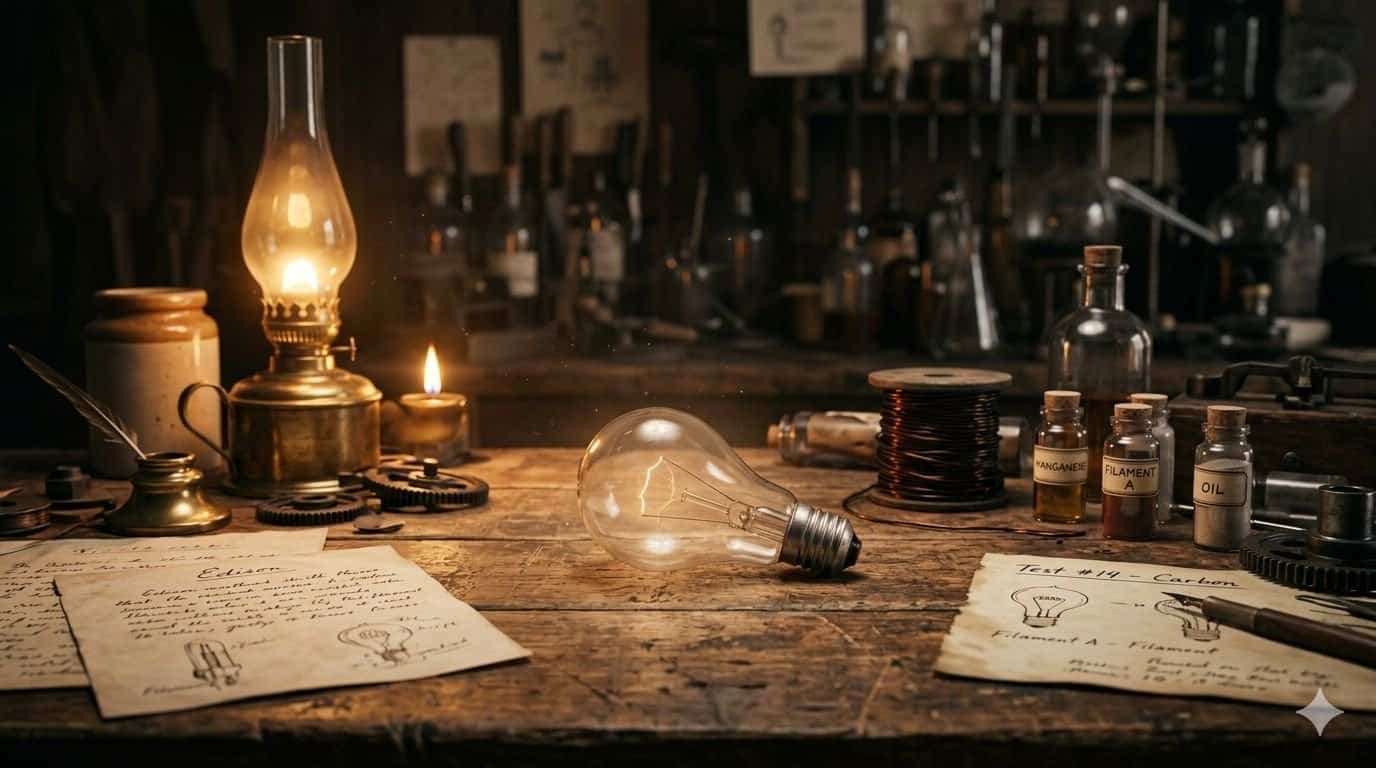
The most famous example is the light bulb. Edison and his team at Menlo Park ran thousands of experiments testing possible filaments before finding one that worked reliably — carbon-coated thread, in 1879. When a reporter asked him how it felt to have failed so many times, Edison’s reported reply has become one of the most quoted sentences in American history: I have not failed. I’ve just found 10,000 ways that won’t work. Edison genuinely did not experience unsuccessful experiments as failure. He experienced them as data.
A Story to Sit With
In the winter of 1879, Thomas Edison had been working on the light bulb for more than a year. His investors were growing nervous. The press was skeptical. A rival inventor publicly declared that Edison’s approach was fundamentally flawed and would never produce a working lamp.
Edison went back to his notebooks.
On October 22, 1879, he placed a carbonized cotton thread filament inside a glass bulb, pumped out the air, and ran a current through it. It glowed. It kept glowing — for thirteen and a half hours. Edison and his team sat and watched it through the night.
The light you read by tonight — wherever you are, whatever lamp is near you — exists because one man decided that the most certain way to succeed was always to try one more time.
Scripture Cross-Links
Galatians 6:9 — “And let us not be weary in well doing: for in due season we shall reap, if we faint not.”
James 1:3–4 — “Knowing this, that the trying of your faith worketh patience. But let patience have her perfect work, that ye may be perfect and entire, wanting nothing.”
D&C 58:4 — “For after much tribulation come the blessings.”
Thematic Reflection
We are strangely comfortable with the idea that greatness requires talent, and strangely resistant to the simpler truth that it requires persistence. Edison named this directly: our greatest weakness is not stupidity, not lack of talent, not bad luck. It is giving up.
The light bulb story is instructive not because it ends in triumph — but because of what Edison was doing during the thousands of attempts that did not. He was learning. He was eliminating. He was getting closer in ways that did not feel like progress but were.
Richard’s Personal Reflection
Medicine is full of Edison moments — though we rarely call them that. You treat a patient’s blood pressure with one medication and it doesn’t work, so you try another. The pain doesn’t resolve with the first approach, so you look again. The diagnosis that seemed obvious at the first visit turns out to be incomplete by the third.
I will say this plainly: the patients who recovered most fully from serious illness were, in my observation, rarely the most naturally robust. They were most often the ones who tried one more time. Persistence in a patient is its own kind of medicine. I have seen it work when nothing else did.
Grandfather’s Counsel
My dear ones, you will reach moments in your lives when it will seem entirely reasonable to stop trying. The evidence, as you will see it, will point toward giving up.
I want you to remember Thomas Edison in that moment. Not the famous one with the patents and the photographs and the Wizard of Menlo Park — the quiet one, in the laboratory at midnight, on attempt number 4,000, changing out one more filament, refusing to let the scoreboard of the day determine what was still possible tomorrow.
He was not certain he would find the answer. He was simply certain that giving up would guarantee he wouldn’t.
That is enough certainty to act on. It has always been enough. Try one more time. One more time is always available to you. And in the economy of Heaven, the person who keeps trying — who shows up when it is hard and attempts again when the attempt has already failed — is already doing something close to sacred.
Press on, my dear ones. Press on.
An Honest FriendNext →
What Posterity Hears — Henry Ward Beecher
If this spoke to you, sit a while with